Hard to measure, but surely there. Vol. Ⅱ
What I Found and Struggled
― 見えなくても、確かにそこにあるもの ―
― 発見と葛藤の日々 ―
September 2014.
It may have been the moment I felt most confident in my entire life.
Loughborough University gave me an extraordinary opportunity to pursue my research theme as a PhD researcher. The university is located in a quiet rural town named Loughborough in the English Midlands.
To open the new chapter of my life, I got onboard an East Midlands Train from London's St Pancras. It was about a two-and-a-half-hour journey. As the English countryside rolled past the window, my mind drifted back to the years since I'd first crossed the ocean in May 2011. I had come to the UK to start over — to rebuild my life from scratch. And the first step toward that was getting into a master's programme. But before that, I had to get through IELTS.
I still remember the day I had a panic attack mid-lesson at a language school — my teacher led me outside, and I sat in a nearby park and cried like a child. I didn't care if anyone was watching or what they might think. I simply couldn't hold back the tears. My emotions were beyond my control.
When I finally got into the university I'd hoped for, I could barely understand my professors, let alone my classmates. My main supervisor held a PhD in philosophy, and even the simplest things were expressed through dense philosophical vocabulary — it had a character all of its own. At the beginning, I couldn't even follow basic schedule announcements — I once turned to an American classmate sitting behind me and whispered, "I have no idea what he just said." She laughed and whispered back, "Neither do I. That's not an English problem." We both burst out laughing. It was one of the most reassuring moments of my time there.
She later told me something I've never forgotten when I was struggling: "Nobody expects perfect English from you, Momoko. What everyone wants to know is what you think, what you care about, what excites you . You wouldn't expect a foreigner in Japan to speak perfect Japanese, would you? It's the same thing. Just say what you want to say.
I followed her advice. As a result, many of my classmates developed a unique skill — guessing what I was trying to say. They were patient, and remarkably good at understanding the things I couldn't yet find the words for in English.
And yet — there I was, standing in Royal Albert Hall, draped in an academic gown, throwing my mortarboard into a clear blue sky alongside the classmates who had shared every high and low with me. I have never felt more proud of myself than at that moment. I had found a research theme I was truly passionate about, secured British funding, and was now stepping into a PhD programme. It felt like a dream.
The announcement calling out "Leicester" brought me back from my thoughts. Through the window, the city where Shinji Okazaki, a Japanese football player, once played was slipping past. Loughborough was next.
I rented a flat in the town. The room seemed to shine — as if everything was glowing with the promise of a new beginning. I was determined to rebuild my career from here.
I had always been drawn to the concepts and approaches of Service Design — but I also had a feeling that something essential was missing. And that feeling had brought me this far.
"Service Design" combines, as the name suggests, two words: "service" and "design." On the surface, they sit side by side as equals. But in practice, the discussion was always driven by the "design" side. "Service" was conspicuously absent. Given its roots in design discourse, this was perhaps inevitable — but the result was that across both academia and practice, there was almost no one with a genuine background in "service."
Service Design needed someone with "service" in their DNA to breathe more of the service spirit into it. Someone had to do it. And I decided that someone would be me.
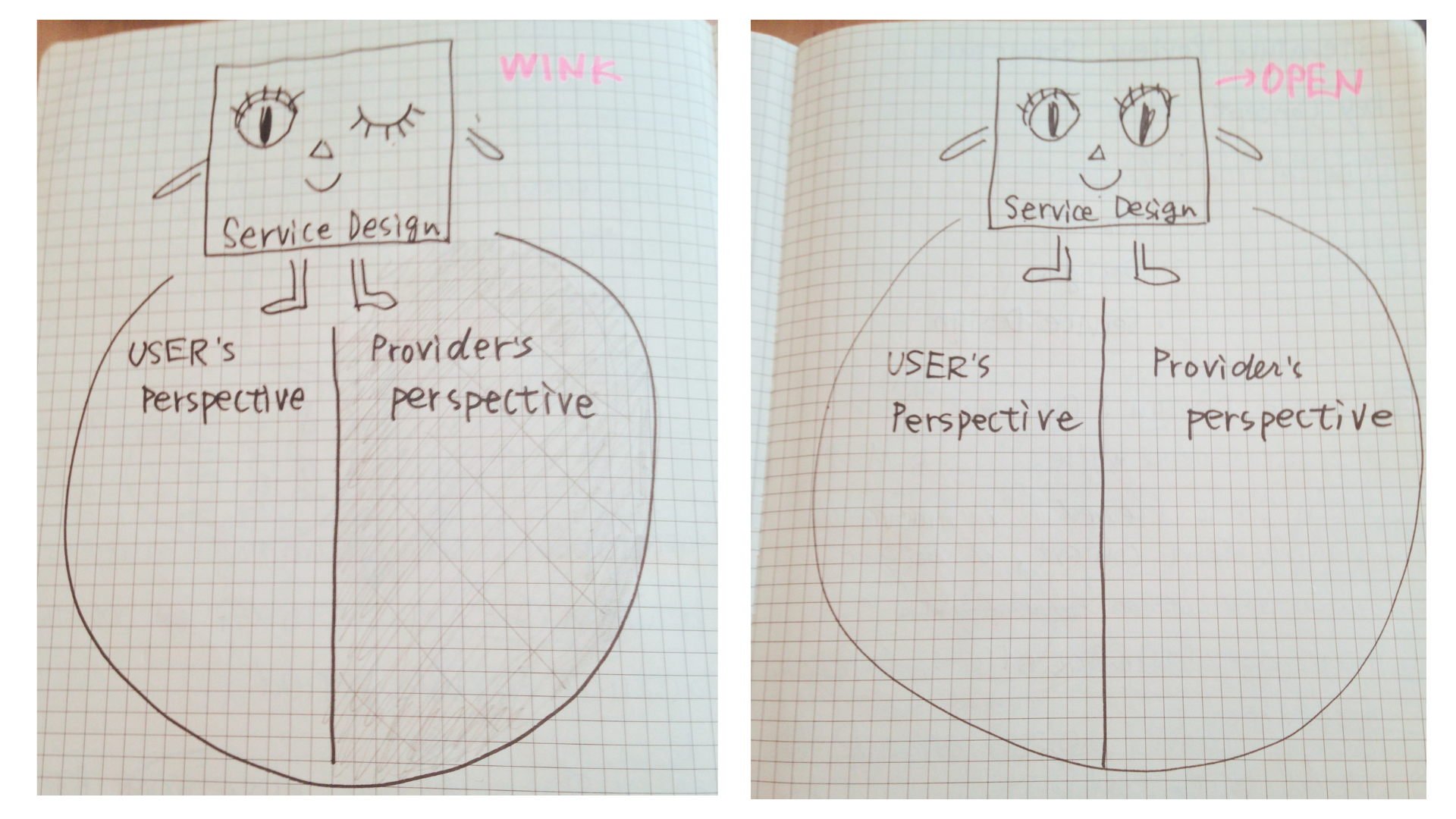
I joined the newly established Service Design Centre for Doctoral Training — a joint programme between the design school and the school of arts. Future doctorate holders had gathered from around the world. Engaging in abstract discussions with such brilliantly sharp peers was no easy feat for me — and yet I didn't suffer. It was just endlessly stimulating.
For researchers in the humanities, language is the ultimate weapon. Conducting research and surviving in academia without your mother tongue is a significant challenge — and yet I barely gave it a thought. Because sometimes, there were moments when something clicked beyond the reach of words — a kind of understanding that didn't need any verbal explanation.
I can no longer say exactly when the excitement and stimulation began to curdle into disappointment and self-doubt. The shift was gradual, and the trigger, if there was one, is lost to me now.
In British academia, each degree level carries a clearly defined minimum standard. For a PhD, the benchmark is whether you can plant the seeds of an entirely new subject in your field. Concretely: you take the arguments and discussion points from your master's thesis, form a hypothesis, test it through research, draw out new perspectives and concepts from your findings, and then give shape and terminology to phenomena that have not yet been named or recognised. That is what earns you a doctorate.
And that is precisely why you are subjected to critique. You are, by definition, working on things that lack shape, that cannot yet be explained in words — so of course very few people will understand you at first. In fact, that rarity is the point. A topic that everyone already knows and readily understands has no value as a PhD research question.
I understand that now. The more critique you receive, the more it signals that your theme is provoking genuine interest. That is where value and meaning live. But at the time, I couldn't see it that way. I am, entirely and without question, the type of person who thrives on encouragement. As the critiques mounted, my confidence slowly but surely collapsed. Eventually, I lost the ability to fully believe in the very theme I had chosen to believe in.
Day after day in that quiet Midlands town, I spent most of my waking hours reading, thinking and writing. I would labour for days over a few sentences, then delete every single word the following morning. Meanwhile, social media was full of people my age achieving things, living fully, radiating energy. The gap between their glittering lives and my grey days made my head spin.
"I've come all this way. What on earth am I doing here?"
That thought made me afraid to go outside. The curtains stayed closed. I retreated further into my room with each passing day. And as if things weren't hard enough already, the supervisor who had believed in me — who had believed in my potential even more than I did — fell ill and disappeared from my life with devastating speed.
I had no choice but to take a leave of absence.
If I'm looking for a simple explanation for my unravelling, it comes down to this: I didn't have enough courage. That's all it was.
To be continued…