Light and Colour at LAX
Landed at Los Angeles International Airport — LAX. My first time.
1pm.
Walking towards the domestic transfer gates.
Ten hours from Tokyo Haneda. The midday California light poured through the large windows, greeting me gently. I felt comfortable. A strange feeling after a long-haul flight. Couldn't quite explain why.
There was a UFO-shaped building outside. It reminded me of Space Mountain at Tokyo Disneyland — a place I hadn't visited in years. I found my shadow cast across the corridor floor. The beauty of contrast, light and shadow, caught my eye. Without thinking, I reached for my phone.
A four-hour transit. Grabbed coffee, first. Found a good spot, sat down — and in that moment, the mystery of this comfort revealed itself.
The purplish navy of the Coffee Bean sleeve
The blue dots on the desk panel behind it
The teal blue of the waiting area chairs
The clear blue sky
The navy of a United tail fin on the tarmac
The turquoise of a water bottle's packaging
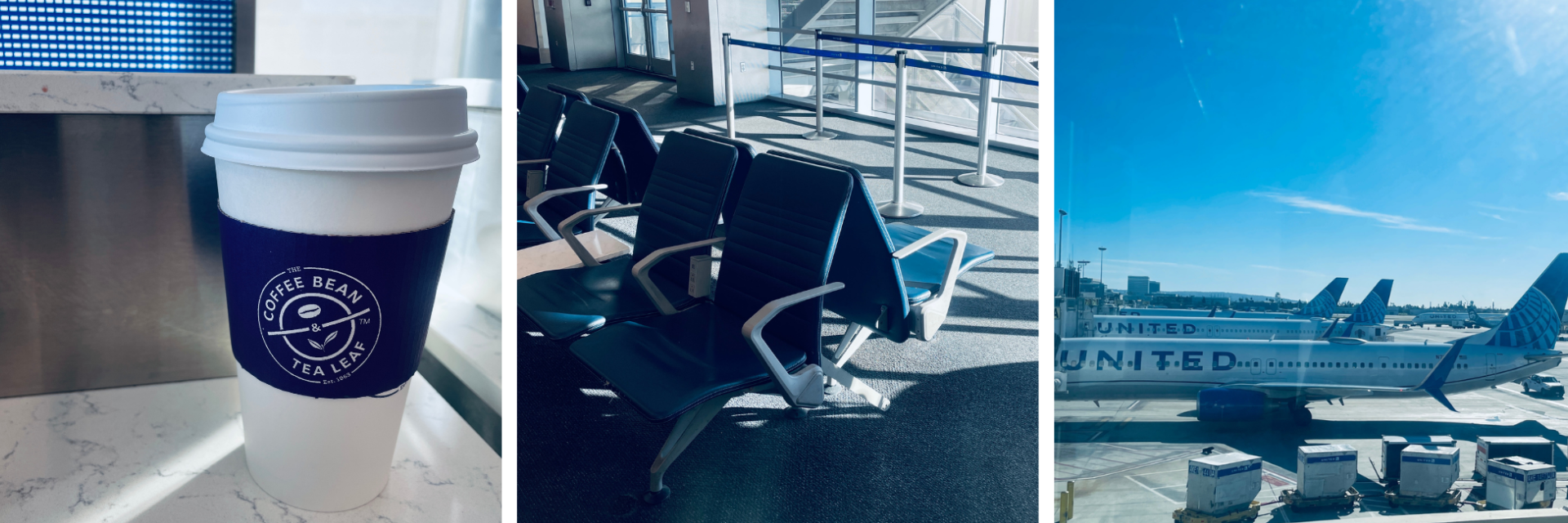
California's dazzling light, pouring over all of it.
How beautiful. I caught my breath and looked around.
The signage font — Helvetica, perhaps. Crisp white letters stood out against a deep ultramarine background. Even the colour of the bins blended in.
Then, it clicked. The source of this comfort — a harmony of light and colour.
Sipping my coffee, a thought came to me.
For years, I may have been constantly observing and analysing airport experiences through the lens of service design.
I don't work under the title of "service designer." Still, that particular way of seeing has become embedded in me — part of who I am. Whether I'm at an airport for business or holiday, I don't think I've ever fully switched it off.
In service design, the airport customer experience is a classic, well-established theme. There are countless case studies, and I'm well aware of the efforts airlines and airport operators put in.
Yet the comfort I felt at this airport was clearly something from an entirely different dimension — not the outcome of a meticulously designed customer journey.
The transfer process wasn't exceptionally smooth.
The signage wasn't particularly intuitive.
There was no special service I couldn't have found at another airport.
This comfort was something felt through the senses.
A harmony born of light and colour.
Collect data.
Quantify findings.
Draw insights.
Then, based on those results, carefully design the entire customer journey.
What I felt here existed on a completely different plane from all of that.
And then, I think I understood why I had never quite been able to ride the wave of the times.
I had never seen service design as a new tool for generating revenue, nor as something to be consumed on the assumption that it would fade once the trend passed. That, I realised, was why I had felt a sense of discomfort using service design in a business context.
What I hold dear is perhaps something difficult to scale into mass-market services.
After all, my way of seeing things is more aesthetic, more philosophical.